
Combating for the well being of the planet with AI | MIT Information
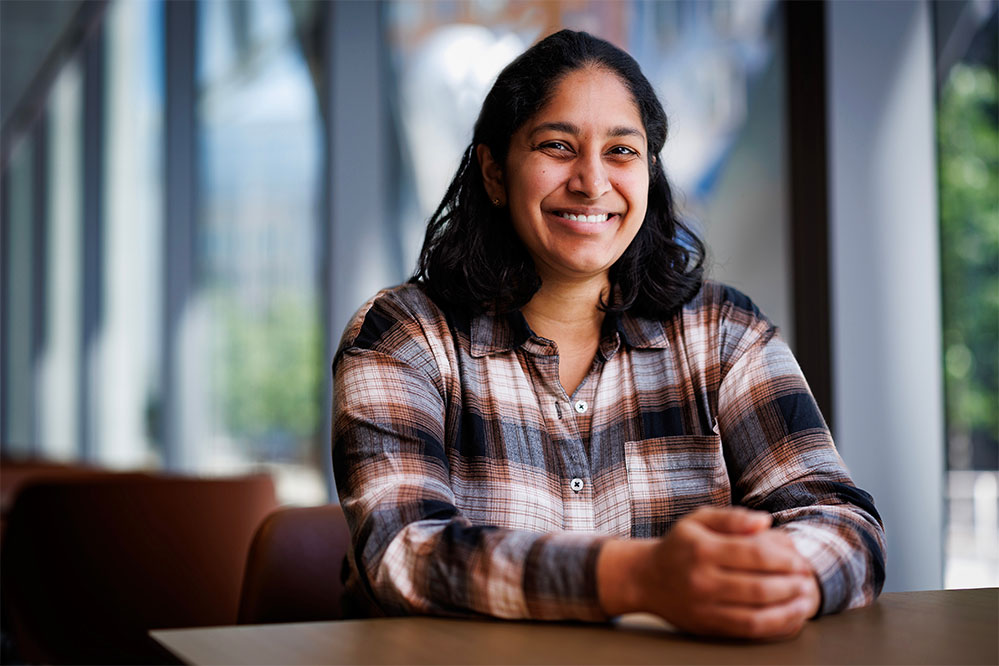

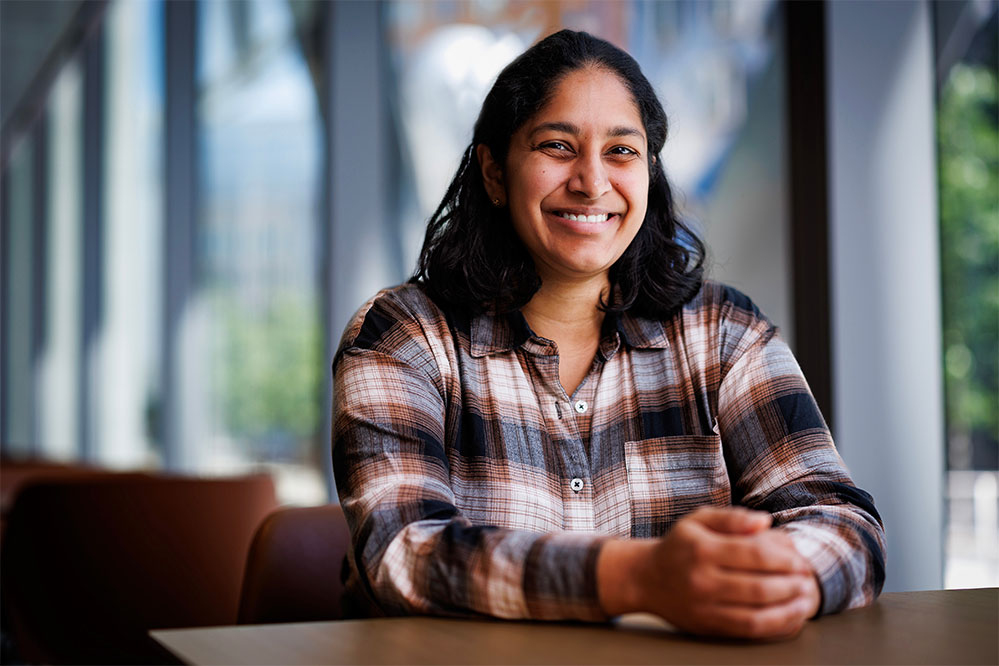
For Priya Donti, childhood journeys to India have been greater than a chance to go to prolonged household. The biennial journeys activated in her a motivation that continues to form her analysis and her instructing.
Contrasting her household dwelling in Massachusetts, Donti — now the Silverman Household Profession Improvement Professor within the MIT Division of Electrical Engineering and Laptop Science (EECS) and a principal investigator on the MIT Laboratory for Info and Resolution Methods — was struck by the disparities in how individuals dwell.
“It was very clear to me the extent to which inequity is a rampant difficulty all over the world,” Donti says. “From a younger age, I knew that I positively needed to deal with that difficulty.”
That motivation was additional stoked by a highschool biology trainer, who centered his class on local weather and sustainability.
“We realized that local weather change, this big, vital difficulty, would exacerbate inequity,” Donti says. “That basically caught with me and put a fireplace in my stomach.”
So, when Donti enrolled at Harvey Mudd Faculty, she thought she would direct her power towards the research of chemistry or supplies science to create next-generation photo voltaic panels.
These plans, nonetheless, have been jilted. Donti “fell in love” with pc science, after which found work by researchers in the UK who have been arguing that synthetic intelligence and machine studying could be important to assist combine renewables into energy grids.
“It was the primary time I’d seen these two pursuits introduced collectively,” she says. “I received hooked and have been engaged on that subject ever since.”
Pursuing a PhD at Carnegie Mellon College, Donti was capable of design her diploma to incorporate pc science and public coverage. In her analysis, she explored the necessity for elementary algorithms and instruments that would handle, at scale, energy grids relying closely on renewables.
“I needed to have a hand in creating these algorithms and gear kits by creating new machine studying methods grounded in pc science,” she says. “However I needed to ensure that the best way I used to be doing the work was grounded each within the precise power programs area and dealing with individuals in that area” to supply what was truly wanted.
Whereas Donti was engaged on her PhD, she co-founded a nonprofit known as Local weather Change AI. Her goal, she says, was to assist the neighborhood of individuals concerned in local weather and sustainability — “be they pc scientists, teachers, practitioners, or policymakers” — to return collectively and entry assets, connection, and schooling “to assist them alongside that journey.”
“Within the local weather area,” she says, “you want consultants specifically local weather change-related sectors, consultants in several technical and social science instrument kits, downside house owners, affected customers, policymakers who know the rules — all of these — to have on-the-ground scalable impression.”
When Donti got here to MIT in September 2023, it was not shocking that she was drawn by its initiatives directing the applying of pc science towards society’s greatest issues, particularly the present risk to the well being of the planet.
“We’re actually fascinated by the place know-how has a a lot longer-horizon impression and the way know-how, society, and coverage all should work collectively,” Donti says. “Know-how is not only one-and-done and monetizable within the context of a 12 months.”
Her work makes use of deep studying fashions to include the physics and arduous constraints of electrical energy programs that make use of renewables for higher forecasting, optimization, and management.
“Machine studying is already actually extensively used for issues like solar energy forecasting, which is a prerequisite to managing and balancing energy grids,” she says. “My focus is, how do you enhance the algorithms for truly balancing energy grids within the face of a variety of time-varying renewables?”
Amongst Donti’s breakthroughs is a promising resolution for energy grid operators to have the ability to optimize for price, taking into consideration the precise bodily realities of the grid, relatively than counting on approximations. Whereas the answer shouldn’t be but deployed, it seems to work 10 instances sooner, and way more cheaply, than earlier applied sciences, and has attracted the eye of grid operators.
One other know-how she is creating works to supply knowledge that can be utilized in coaching machine studying programs for energy system optimization. Basically, a lot knowledge associated to the programs is non-public, both as a result of it’s proprietary or due to safety issues. Donti and her analysis group are working to create artificial knowledge and benchmarks that, Donti says, “will help to show a few of the underlying issues” in making energy programs extra environment friendly.
“The query is,” Donti says, “can we carry our datasets to a degree such that they’re simply arduous sufficient to drive progress?”
For her efforts, Donti has been awarded the U.S. Division of Vitality Computational Science Graduate Fellowship and the NSF Graduate Analysis Fellowship. She was acknowledged as a part of MIT Know-how Evaluation’s 2021 checklist of “35 Innovators Beneath 35” and Vox’s 2023 “Future Good 50.”
Subsequent spring, Donti will co-teach a category known as AI for Local weather Motion with Sara Beery, EECS assistant professor, whose focus is AI for biodiversity and ecosystems, and Abigail Bodner, an assistant professor in Earth, Atmospheric and Planetary Sciences, holding an MIT Schwarzman Faculty of Computing shared place with EECS.
“We’re all super-excited about it,” Donti says.
Coming to MIT, Donti says, “I knew that there could be an ecosystem of people that actually cared, not nearly success metrics like publications and quotation counts, however concerning the impression of our work on society.”