
How AI Corporations Bought Caught Up in US Army Efforts
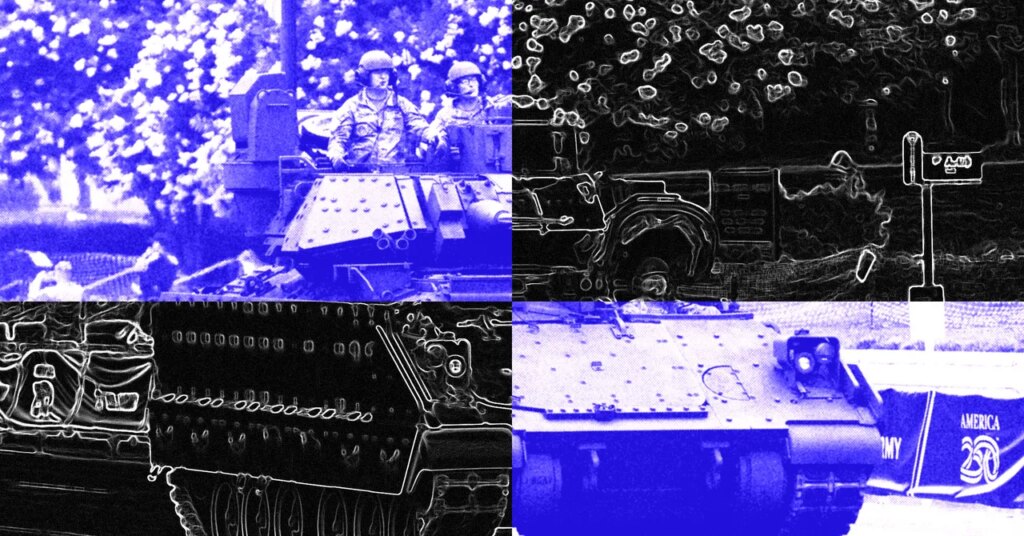

Initially of 2024, Anthropic, Google, Meta, and OpenAI had been united towards navy use of their AI instruments. However over the subsequent 12 months, one thing modified.
In January, OpenAI quietly rescinded its ban on utilizing AI for “navy and warfare” functions, and shortly after it was reported to be engaged on “various tasks” with the Pentagon. In November, in the identical week that Donald Trump was reelected US president, Meta introduced that america and choose allies would be capable of make use of Llama for protection makes use of. Just a few days later, Anthropic introduced that it too would permit its fashions for use by the navy and that it was partnering with the protection agency Palantir. Because the yr ended, OpenAI announced its personal partnership with the protection startup Anduril. Lastly, in February 2025, Google revised its AI rules to permit for the event and use of weapons and applied sciences that may hurt individuals. Over the course of a single yr, worries concerning the existential dangers of AGI had nearly disappeared, and the navy use of AI had been normalized.
A part of the change has to do with the immense prices concerned in constructing these fashions. Analysis on general-purpose applied sciences (the different GPTs) has typically highlighted the significance of the protection sector as a method to overcome problems with adoption. “GPTs develop sooner when there’s a big, demanding, and income-generating utility sector,” economist David J. Teece wrote in 2018, “such because the US Protection Division’s purchases of early transistors and microprocessors.” The comfortable price range constraints and long-term nature of protection contracting, mixed with the usually blurry metrics of success, make the navy a extremely fascinating buyer for brand new applied sciences. Given the necessity of AI startups, specifically, to safe giant and affected person investments, the flip to navy funding was maybe inevitable. However this doesn’t clarify the rapidity of the shift nor the truth that all of the main American AI analysis labs moved in the identical path.
The previous few years have dramatically shifted the panorama of capitalist competitors—from one guided by neoliberal free market beliefs to at least one saturated with geopolitical issues. To know the shift from neoliberalism to geopolitics, one should grok the relationships between states and their giant expertise firms. Such state-capitalist relationships have been central to earlier formations of imperialism—Lenin famously characterised the imperialism of his period as a merger between monopoly capital and nice powers—they usually remained influential all through the twentieth century. In latest many years, this took the type of a broad consensus between the tech and political elite about digital expertise’s position in innovation, progress, and state energy.
Over latest years, nevertheless, this concord of pursuits amongst elite teams has unraveled. A sequence of overlapping processes, gathering specific momentum within the 2010s, has dismantled this order, forsaking the fragments of doubtless new preparations in each america and China.
The Silicon Valley Consensus
Up till concerning the mid-2010s, america was dominated by what is likely to be referred to as the Silicon Valley Consensus. Right here there was a broad settlement throughout each the political elite and tech elite concerning the position of expertise on this planet, about what was required with a view to permit that expertise to flourish, about what purportedly American values they embodied, and concerning the necessities for capital accumulation within the expertise sector. For each the tech elite and the political institution, globalized communication, capital, knowledge, and expertise served their pursuits.
The Silicon Valley Consensus appealed to each tech and political elites as a result of it was a perception in expertise’s capability to create an American-led world of borderless commerce and knowledge. Whereas the tech sector could have (initially) had extra utopian impulses than the hardheaded geopolitical realism of the state, each might see their mutual tasks achieved by means of the identical means.
In follow, this meant a free hand was given to the tech sector, with rules both conspicuously absent or curiously facilitating. Deregulation was after all a core aspect of the broader neoliberal interval, nevertheless it notably utilized to tech firms with their capability to confuse present regulatory classes and “disrupt” present guidelines. The dearth of any vital federal privateness legal guidelines or motion on the standing of employees within the gig economic system is indicative of this broad willingness to let digital corporations act as they please. Underneath President Invoice Clinton, the Framework for International Digital Commerce set out insurance policies that, according to international studies professor Henry Farrell, succeeded in “discouraging policymakers from in search of to tax or regulate” the digital economic system—and as an alternative turned to voluntary, industry-led regulation. The core perception right here—one that is still operative to today—was that any regulation would merely get in the way in which of innovation and the enlargement of US expertise and energy.